The Condor
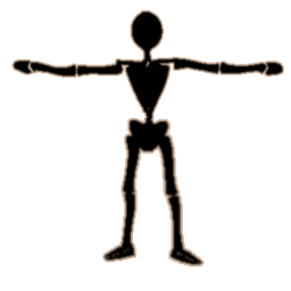
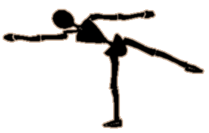
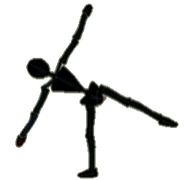
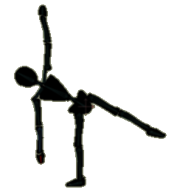
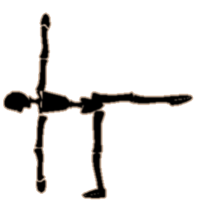
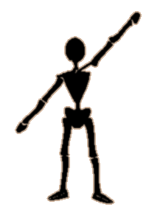
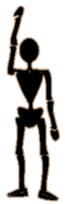
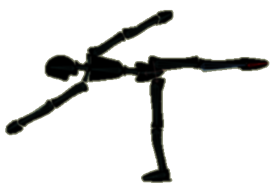
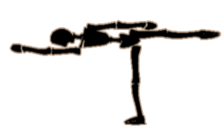
The shoulders are yoked with the feeling of the arms being pulled outwards, with the sternoclavicular joint being the fulcrum.
The Condor is quintessentially about yoking; the harnessing of two parts (or more), of the body to behave as one, and the acquiring and focusing of more than one sensation to produce an enhancement of consciousness in our exploration of our physical form. The result is spiritual.
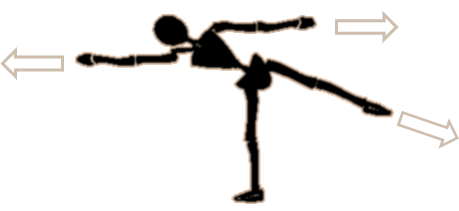 The arms and legs have the feeling of extension, of always being pulled outwards, away from the yokes centre.
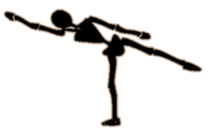
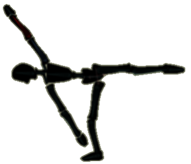
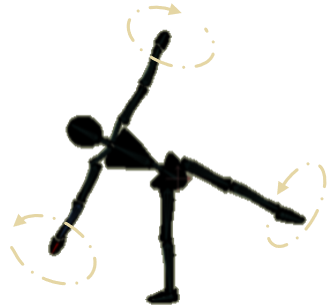 The extended leg can circle concordantly with the arms producing synchronized movement.
~
The Condorkirkos
When doing the Condor circles, you can let the arms flow through the shoulders to loosen the yoke, and flow in the direction from the focused hand to its counter, as well as keeping the structure rigid in its purer form. It is more about the yoking of sensation, than it is about rigidity of form. All of Pentegraph is about how it feels, not how it looks.
Exwhy
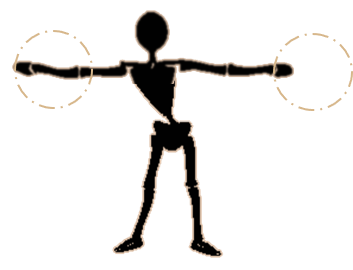
Lateral movement at waist creates x, shoulders move up and down creating y, the whole thing makes hands do circles xy. Focus upon the shoulders performing the circles, keeping them yoked and rigid; the waist movement and spine flexibility creates the fluidity.
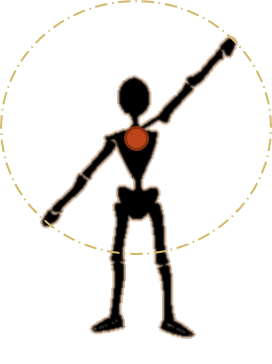
The fulcrum for the Olikos Condorkirkos is the sterno-clavicular joint. It is this point in space that needs to be kept still while the body rotates around it, twisting left and right, while the arms circulate either side of the body.
Whyzed
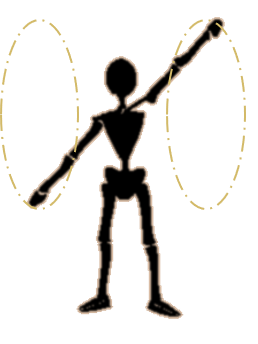
Because of the shoulder joints yoking at the sternoclavicular joint, all the circles produced without actual body movement are Whyzed's in the Condor.
To perform a strict yoke in the Condorwhyzed, it is necessary for the body to twist and turn in a tumble as it gets out of the way of the momentum of the windmill that is produced when the arms are vertical.
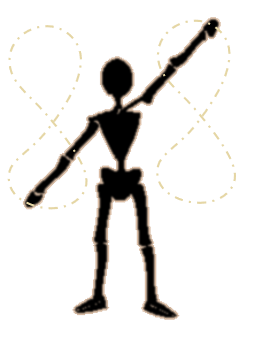
The joining of two Whyzed Kirkoi produce a Dykirkos. This is an Condordykirkos. The changing of direction is achieved by using the Penter in the Looming Condor.
Zedex
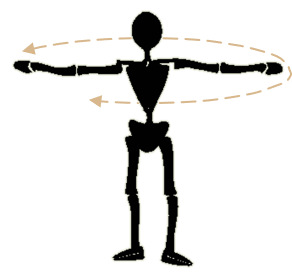
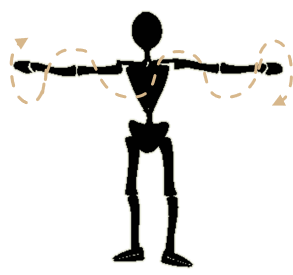
Twisting the body around 180º with the arms outstretched and yoked, and then creating circles while the movement is happening, creates a wavy line along the path with circles at the point of reversal.
If the end circles have only one connecting wave it becomes a Dykirkos with a Whyzed action and therefore is a Zedexwhyzed.
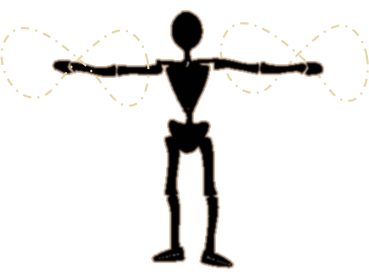
With enough movement it all turns into a soup of x, y and z, and nomenclature becomes less and less applicable; it is then called the Exwhyzedexwhyzed!
~
The Condorpenter
Effectively, this is just the rotation of the Condordykirkos and allows the reversing of the Condordykirkos. But joining the circles up of the Pentegraph Orb with the shoulders yoked in the Condor, is not as easy as you would imagine. It is much easier using Dragonfly and easiest with Hawk.
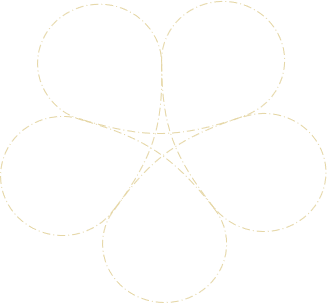
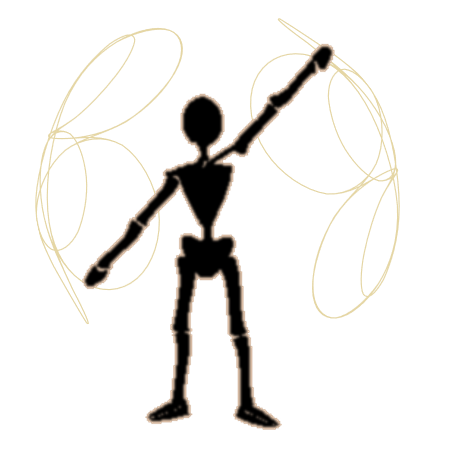
The Condor on the Gate has to be performed within the Pentegraph Orb rotated 90º from its normal orientation. It is effectively using one Penter from the upper equatorial and one from the lower equatorial; one is upside down, one is the other way round. So, if the right hand draws an Anabasis Penter, the left will draw a Katabasis Penter. This can also be called the Condorgate.
The Looming Condor is used when a vertical Dykirkos is performed and the direction is reversed.
~
The Condoraster
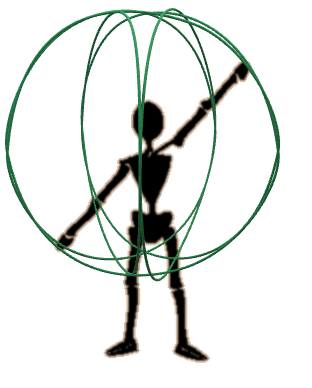
The central pivot is the clavicular joint at the sternum, which remains at the centre of the Aster, with the hands tracing the path of the Aster 180º apart. It is not possible to keep the body stationary during this performance, and it is the arms only that trace the path, with the feet and body moving necessarily to where they are needed to be to achieve the movement, twisting and contorting just to get out of the way. It can make me feel a bit dizzy and disoriented and is quite testing.
It could be a good design for a roller-coaster using this path; it would certainly make me sick!
~
The Condor Passage
The Condor Passage is a sequence of transitioning between the various forms.
The Windmill
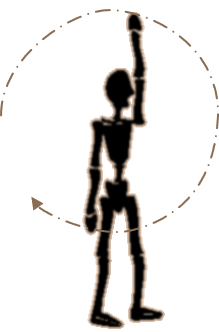
Pivot with the pelvis, letting the supporting limb be pulled into the position it needs to be in. Keep feet together, twisting upon the first feet upon the insistence of the hips as they turn; the feet slide across the ground forced into position by the hips; the arms momentum drives the windmill.
The Crouching Condor
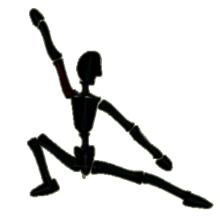
The Wingless Condor
Shoulders only perform the patterns with the sternoclavicular joint as the place to focus the yoke. This doesn't need the usual amount of space to perform and can be done sitting in a chair. Without the distraction that the arms can have, it is a good method for focusing on the yoke and the sensation of its movement and as a preparatory means to practicing the full Condor.
The Stubby Condor
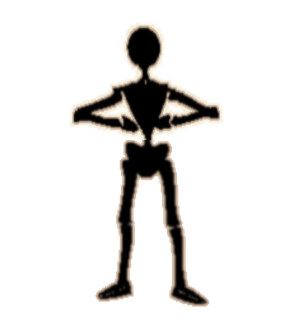
Elbows as wings. Another useful space saving method. The locking of the arms stabilizes the yoke.
The transition between stubby and a fully winged Condor describe an orb for patterning, with the elbow joint being the fulcrum.
The Tethered Penter
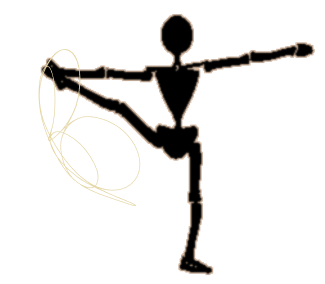
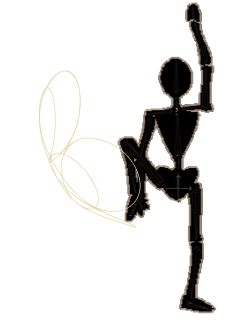
The arm tethered to the foot remains straight while the leg is forced to bend as the foot draws the Penter concomitantly with the hand, while the opposite arm creates a Condor which helps with the balancing, though is not entirely necessary. Easier to do Dragonfly style, with the free hand doing the Gate.
The Tethered Condor Windmill
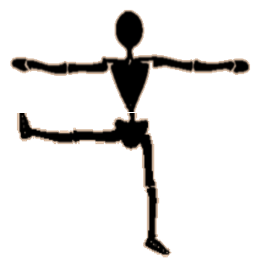
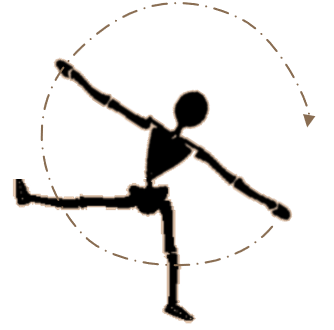
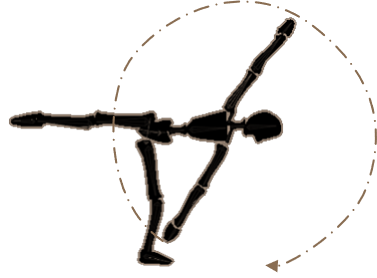
Tethered always refers to the foot being anchored to the hand or something else; in this case the tethering is supporting the foot upon something so that the leg is horizontal, such as a window sill (not shown). After a while the tethering won't be necessary. The twisting that occurs forces the supporting foot to swivel on the ball of the foot (first feet) at the beginning of the turn, and then on the heel for the remainder, and doing the reverse when returning.
The maximum extension (known as the Superman pose!), necessarily has the yoke broken as both arms are pushed and pulled in opposite directions and stretched until reversing the movement and touching the toes.