Aster Genesis

I used to muse upon the concept of how a path other than a great circle would circumnavigate a sphere and join back up with itself. If the path of the great circle deviated so that it did not join back up to itself, how many times would it go round until it did again? It could not do it with 2 encirclings, or 3, or 4; this was obvious by sheer imagination. But 5 was a possibility, and I first saw the potential of it by noticing the pentagram that existed as the path drawn inside the five circle cluster of the Penter, called the Pentenexus, below.
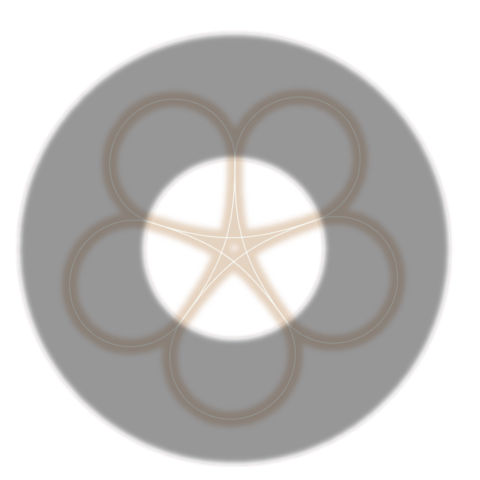
I believed that the path creating this unbroken circumnavigation of the sphere was done via a constant helical turning I called the Entelechic Twist, which used a constant intrinsic curvature to form a three dimensional pentagram. I was unable to find anything about this in any literature or web searches, and later was able to use AI deep research which was also unable to find anything similar (see Analysis of the Aster).
All mathematical models of spherical division use the Great Circle as their foundation, but this 5 turned circumambulation does not have a Great Circle in it and is therefore not in any of the academic covering of the topic. The interactive 3D model below demonstrates that the geometrical form is valid.
Although not realising it until I started to dissect the model into sections, the Aster path actually created 5 perfect circles joined together (illustrated below in an interactive 3D model with different colours for each circle). The original model of it was not created by using circles though, and so it was quite a surprise to me to find that it did, and at first I thought that this unsought serendipity proved the validity of the Aster — which it does in a different way — but then realised that it also proved that it was not a perfect path because of there being a change in the vector of the path at the points of osculation (though it was so slight that it looked continuous). This meant that its definition of being a spherical helix characterized by a constant intrinsic curvature and constant helical divergence, could not be true. The Entelechic Twist was twisted!
The models above are from a second modelling attempt of the Aster, but an interesting thing about the two 3D models is that they both produce the spectre of a straight lined pentagram, completely by accident. My first 3D model, which was created using the Pentenexus as a guiding template, produced a straight lined pentagram view in perspective mode (but concave in orthographic), while my second model — using a different method — produced a view of a straight lined pentagram in orthographic mode (while convex in perspective).
The fact that these 2 viewing modes show this same peculiarity hints that there should be 2 different models, and that they are both worthy of consideration. Whereas the 2nd model can have 5 circles overlap the path precisely, the 1st doesn't allow this (by its very nature), hinting that there is a different thing happening here — which I hope to be the Entelechic twist of my first conceptualising — but as of yet I cannot prove this.
The sheer synchronicity that two different models, created by two independent methods, both serendipitously produced the visually straight-lined pentagram (entirely without intention or design) is possibly not a coincidence; it could be a powerful conceptual validation that the Aster's perfect, continuous, twist-only form must actually exist. The first model, which resists the simple five-circle overlap, may therefore likely hold the key to this idealized form.
But my first model was not very well made, and after I created the second, I deprecated the first in favour of the better produced second model. But I now think that it still has merit but does not have demonstrable quality. More work is needed, but then that applies to the whole of Pentegraph too.
So, I think it might be too early to write off the Aster as being only the joining of 5 circles with Wickets creating the bifurcated paths necessary for encirclement of a sphere. My first rendition of it may still prove to have the constant intrinsic curvature and constant helical divergence necessary to produce a continuous twisting wrap around a sphere, without deliberate divergence. I just need better modelling skills to prove it.
•••
The Aster is a continuous path composed of five interlocking circles. This secondary definition highlights that the Aster's continuity is achieved through the Wickets, which serve as points of osculation where the path seamlessly transitions from one circle to the next. The bifurcation at these points is what allows for the continuous path around the sphere. It is a justifiable property in its own right — the ability for a series of simple circles to weave together into the powerful form of the pentagram.
The Aster is literally made out of 5 interlocking circles, even though this is not the way I originally conceived of it or created the first 3D model of it. At every point of osculation there is a Wicket (where the path intersects with another part of the path) which allows for there to be a swapping of the path. In the Aster, this effectively reverses the direction, and unbeknownst to me during the making of it, also produces a perfect circle.
These Wickets are like magnets, and whenever a circle touches one its path is drawn into the other circle, drawing it around the sphere in an unending encircling. The thing that happens in the Aster at the osculation points, is the legitimate construction of a perpetual path. The vector changes at these 5 osculating points, but the path is continuous, and is a twisting of the path producing a change in direction. To maintain motion around the sphere the path will veer off into the next circle naturally by their sheer proximity and attraction. The kink has to happen, otherwise it just stays a circle. Other vectors or paths do not do this, they just become the other helical structure — the Loxodrome — which disappears into the poles and fails to circumnavigate the entire sphere. It is the signature of the Aster to be made of 5 circles and flagged by these Wickets! This is the way it does it — the smallest number of turns to fully circumnavigate the sphere (other than the great circle).
The Aster's beauty and complexity lie in its ability to harness the power of simple circles and interweave them through five transition points to create a continuous, holistic, circumnavigating path — a composite Spherical Helix.
~
Aster La Vista
Let the Aster be your guiding star.
My original concept for the practice and usage of the Aster was for exercise and esoterical prayer. One wish upon this star was for it to be the unending technique to fully exercise the shoulders — by the use of the arms performing an Aster Dragonfly at full extension: the Olikos Astergate.
Drawing a pentagram around you for protection, is a literal description of the Olikos Astergate — full arm length encircling of body using Whyzedexwhy. Done with vigour and speed, it can be imagined that this would be able to repel attacks from all sides simultaneously.
•••
The Book of 5 Rings
Surely this is a reference to the 5 circles of the Aster or Penter! It can't be only me that has discovered this. I believe it is possible that Miyamoto Musashi had mastery over these movements and used them in his martial activity. There is a strong martial aspect within the performance of the Aster and Penter. It is easy to see how a great martial artist could use it as the perfect training template. The naming of it as the Book of 5 Rings is a sign to those who know, but to others will be entirely obscure; as has shown to be through history.
~